Latest update: Citizens of more than 30 countries killed in Himalayan flood disaster, 1,500 missing
On August 26, a catastrophic flood struck the border region of Nepal and China in the Himalayas, marking one of Nepal's most severe natural disasters. According to data from the Nepal Police and Chinese authorities, the death toll is continuously rising. It is currently nearly 500. Approximately 1,500 people are missing.
reede, 28. august 2026 07:54
What happened?
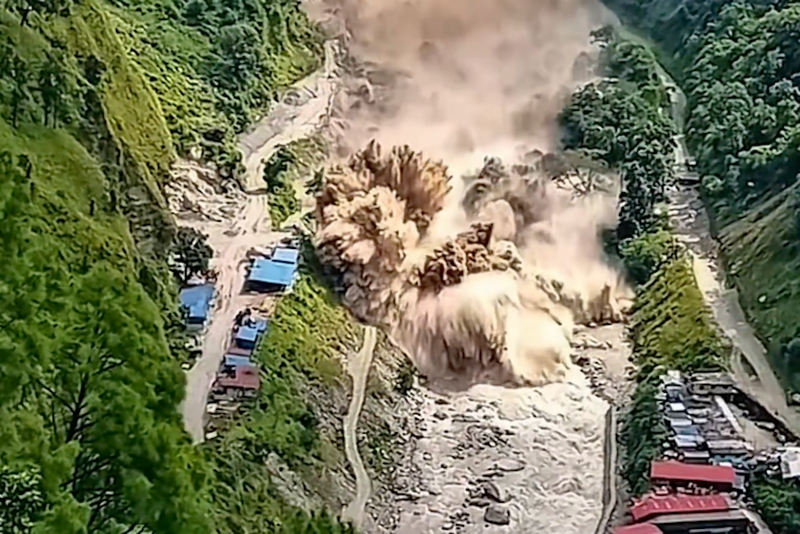
According to preliminary assessments by authorities and scientists, the disaster was triggered by a glacial collapse, or an ice avalanche, on the Lhende Khola river, located about 64 kilometers north of Kathmandu in the Langtang National Park area. An analysis of seismic data from the United States Geological Survey (USGS) showed that the signals corresponded to a glacial collapse, not an earthquake, although a magnitude 5.2 tremor was also recorded at 08:37 Nepal time.
Nepali officials estimate that an avalanche had blocked the Lhende Khola river, forming a glacial lake. Its release unleashed a massive volume of water, mud, and rock into the valleys, moving at up to 50 meters per second. This hit settlements up to 80 meters above the river's normal level, washing away bridges, schools, and hydropower plants.
The water and mudflow spread along a 72-kilometer stretch of the Trishuli River, affecting the Rasuwa, Nuwakot, Dhading, Gorkha, Chitwan, Tanahun, and both Nawalparasi districts in Nepal, and the Gyirong County of the Tibet Autonomous Region on the Chinese side.
Death toll
As of the morning of August 28, the number of victims is as follows:
* Nepal: At least 472 confirmed deaths. The highest number of victims has been recorded in the Chitwan district (up to 108), followed by Nawalparasi East, Dhading, Gorkha, and Nuwakot.
* China (Tibet, Gyirong County): 3 deaths.
* Total: At least 475 deaths, with the number continuously rising as search operations continue in buried areas.
Missing
The number of people considered missing has changed repeatedly since the disaster, as communication lines in the region have been cut and roads destroyed.
* In Nepal, 910 people are missing, of whom 517–668 are foreigners from more than 30 countries.
* In China (Gyirong County), 558 people are missing, of whom 260 are foreigners.
* In total, at least 1,468 people are missing—authorities note that the Nepali and Chinese lists may partially overlap.
Among the missing are also 127 Nepali domestic tourists, 28 police officers, 13 members of the Armed Police Force, 44 Nepali Army soldiers, 15 customs officials, and 4 immigration officers.
Injured
The number of injured has increased throughout the day as rescue efforts have progressed. According to the latest data from the Nepal Police, a total of 73 injured have been registered: 43 in Rasuwa, 27 in Nuwakot, and 3 in Dhading. Dozens of injured, including patients in critical condition, have been evacuated by helicopter to hospitals in Kathmandu.
Missing and deceased by nationality
The missing tourists come from at least 34 countries. The most represented are:
* India: at least 178 (some reports suggest ~288–290)
* USA: 65
* Ukraine: 53
* Malaysia: 51
* Australia: 35
* United Kingdom: 33
* Canada: 24
* Chinese citizens in Nepal: approximately 100
* Nepali citizens in China: 100
* South Korea (hydropower project workers): 9
Additionally, citizens from Belarus, Belgium, Bulgaria, Finland, France, Germany, Hungary, Italy, Ireland, Israel, Japan, Kazakhstan, Latvia, Lithuania, Estonia, the Netherlands, the Philippines, Portugal, Russia, Serbia, Singapore, South Africa, Spain, Sweden, and Switzerland have been reported missing. Many of the missing from India were on a pilgrimage to Mount Kailash in Tibet, a sacred Hindu site.
Rescue operations
Nepal has deployed over 9,000 security personnel, including 4,200 soldiers, and has declared the affected areas disaster zones for three months. The Nepali Army has evacuated at least 351 people by helicopter. Prime Minister Balen Shah visited the Nuwakot district on August 27. The Nepali government has declined offers from several countries to send search and rescue teams, citing coordination problems from the joint operation after the 2015 earthquake.
On the Chinese side, the government of the Tibet Autonomous Region has mobilized nearly 800 rescue workers, 150 vehicles, search dogs, and speedboats, also involving units of the People's Liberation Army. Chinese President Xi Jinping has called for continued searches for the missing and for improving disaster monitoring and warning systems.
International aid
The United Nations released $2 million for medical aid, shelter, and water; the International Federation of Red Cross allocated 1 million Swiss francs; the World Health Organization sent emergency medical supplies; and Doctors Without Borders dispatched an emergency team. India sent 50 tons of humanitarian aid, South Korea provided $1 million and a team, the United Kingdom pledged £5 million and a rescue team, the USA offered $500,000 and a disaster advisor.
Warning of a new flood threat
On August 27, Chinese authorities warned that a lake of 2 million cubic meters has formed at the confluence of the Chhochen Khola and Purepu Tsangpo rivers. An additional 3 million cubic meters of water are expected to flow into it before August 30, creating a high risk and potentially causing another devastating flood wave.
Sündmuste ajajoon
Hukkunute arv suureneb
Nepali politsei teatel on kolmapäeval riiki tabanud üleujutustes hukkunud 489 inimest. Surnukehad on leitud kõige enam kannatada saanud Rasuwa ja Nuwakoti piirkondadest, kusjuures enamik neist asub Chitwani piirkonnas, kus voolab Trishuli jõgi ja suubub Seti Gandaki jõkke, teatas BBC.
Toeta nwsTraili
nwsTrail on sõltumatu välisuudiste veebileht. Sinu toetus aitab hoida sisu tasuta.